







Our trusted partners
Drill1881Ranger Energy ServicesJCPenneyOasisFalvez EnergyEctor County ColiseumA-1 Homes
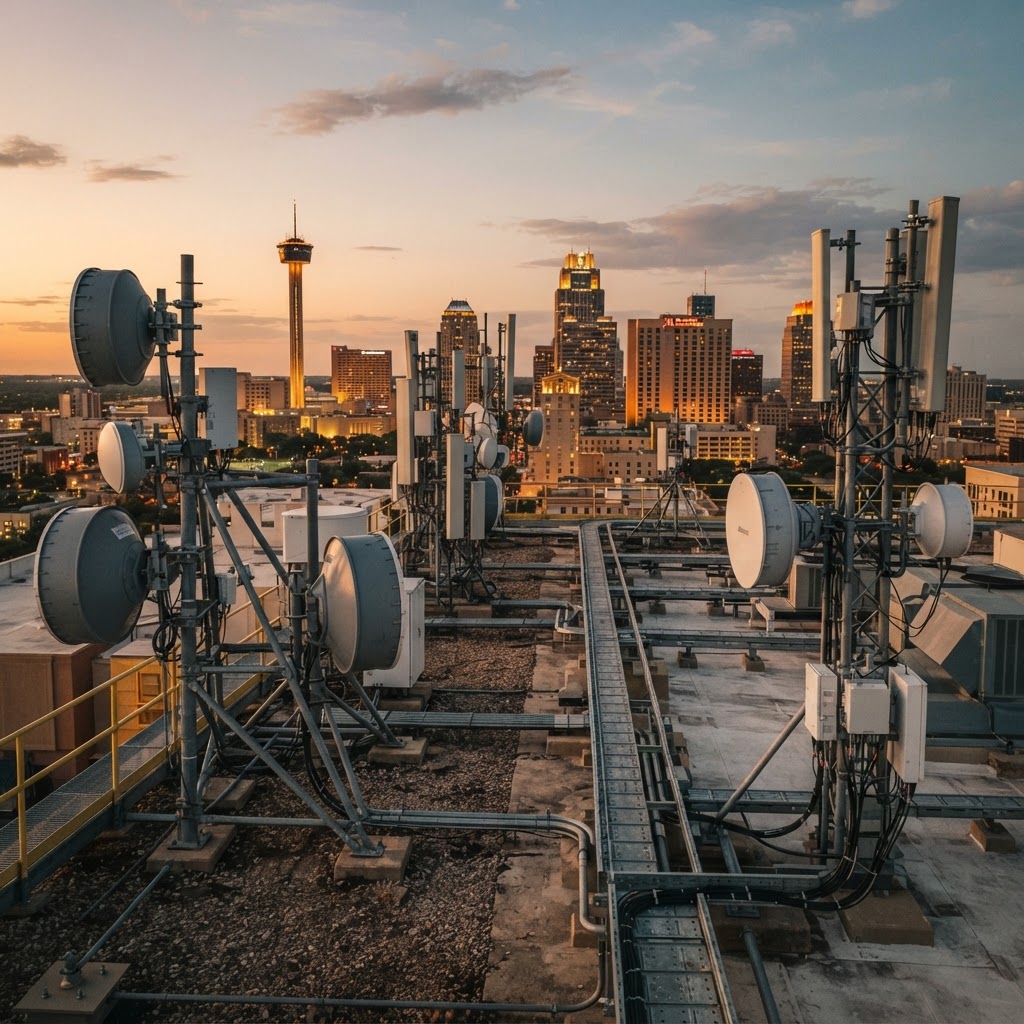
Enterprise telecommunications and wireless network infrastructure in San Antonio Texas
SAN ANTONIO NETWORK ENGINEERING

Point-to-Point Wireless vs. Fiber in San Antonio: Which Is Better for Your Business?

Fiber is fast. Wireless is flexible. So which one should a San Antonio business choose? The answer depends on the location, the application and the network.

Talk to a Network Engineer
Point-to-point wireless and fiber network infrastructure in San Antonio Texas

Fiber is fast. Wireless is flexible. So which one should a San Antonio business choose? The answer isn't as simple as declaring one technology better than the other.

For enterprise networks, the better question is: Which technology makes the most sense for this location, this application and this network?

Sometimes that's fiber. Sometimes it's point-to-point wireless. And increasingly, the best enterprise networks use both. NetWest Online designs telecommunications infrastructure around the actual requirements of the facility rather than forcing every location into the same type of connection. Here's how the technologies compare.

What Is Fiber Internet?

Fiber-optic networks transmit data using light traveling through strands of glass or optical fiber. Fiber can provide enormous capacity with extremely low latency and is the foundation of much of the world's telecommunications infrastructure. NetWest uses fiber extensively throughout our own network and enterprise internet in San Antonio deployments.

For a business located in a building where high-capacity fiber already exists, fiber may be the obvious primary connection. The challenge begins when fiber isn't already where you need it.

What Is Point-to-Point Wireless?

Point-to-point wireless creates a dedicated radio connection between two locations. Directional antennas are installed at each end of the connection and aligned with one another. Instead of installing underground cable across the entire distance between the locations, data travels through the air.

Modern carrier-grade point-to-point wireless systems can provide high bandwidth with very low latency. Depending on the application, frequency, distance, equipment and available spectrum, these systems can support demanding enterprise networks.

Fiber vs. Wireless: The Basic Comparison

FactorFiberPoint-to-Point Wireless
BandwidthExtremely high capacityHigh to very high capacity depending on system and path
LatencyExtremely lowExtremely low on properly engineered links
ConstructionMay require trenching, conduit, permits and right-of-wayPrimarily requires suitable mounting locations and line-of-sight
Deployment TimeCan range from simple installation to lengthy constructionCan often be deployed faster when infrastructure and line-of-sight are available
Physical RouteUnderground or aerial cableThrough the air between locations
DistanceExcellent for virtually any distance with proper network infrastructureExcellent for appropriate line-of-sight paths
RedundancyExcellent when physically diverse routes existExcellent for creating a physically different path from underground fiber
InterferenceNot affected by radio interferenceMust be professionally engineered; licensed spectrum can reduce interference concerns
Construction CostCan become expensive when significant construction is requiredCan avoid major trenching costs in appropriate situations
ScalabilityExceptionalDepends on radio technology, spectrum and path design

When Fiber Makes the Most Sense

Fiber is often the best choice when high-capacity infrastructure already reaches the building. Examples include:

  • Office towers
  • Data centers
  • Large commercial buildings
  • Carrier hotels
  • Major industrial campuses
  • Facilities located along existing fiber routes

If the fiber is already installed and appropriate capacity is available, there may be little reason to replace it with wireless. NetWest's philosophy is simple:

Use the technology that makes sense.

The objective isn't to sell wireless instead of fiber. The objective is to build the right network.

The question isn't whether fiber or wireless is better. The question is which network architecture solves the problem.

When Wireless Makes More Sense

Point-to-point wireless becomes especially attractive when geography or construction makes fiber difficult. Consider a facility located one mile from available fiber. The fiber connection may technically be nearby. But getting it into the building could require:

  • Engineering
  • Permits
  • Underground construction
  • Trenching
  • Boring
  • Conduit
  • Easements
  • Street crossings
  • Railroad crossings
  • Utility coordination
  • Construction crews

That one mile can turn into a significant construction project. Wireless may provide another option. If NetWest can establish a suitable line-of-sight path between the facility and network infrastructure, the final connection may be delivered through the air rather than by constructing underground fiber for the entire distance.

Fiber Without Fiber to the Building

This is one of the most useful applications of point-to-point wireless. Suppose high-capacity fiber exists at Building A. Building B needs the connectivity but is several miles away. Instead of extending physical fiber the entire distance, the architecture can look like this:

Fiber Backbone
NetWest Network Location
Point-to-Point Wireless
San Antonio Business

Point-to-point wireless can extend high-capacity connectivity beyond the physical endpoint of a fiber network.

The customer can receive high-capacity connectivity even though the final portion of the network doesn't travel through underground fiber. This is sometimes described as a wireless fiber extension.

Building-to-Building Connectivity

Another strong application is connecting buildings owned or operated by the same organization. Imagine a San Antonio company with Warehouse A, Warehouse B, a Corporate Office and a Maintenance Facility. The buildings may be separated by parking lots, roads or neighboring properties. Running new fiber between every location may require significant construction.

Point-to-point wireless can potentially create private high-capacity links between the facilities. Applications can include:

  • Shared internet access
  • Private network connectivity
  • VoIP
  • Security cameras
  • Access control
  • File servers
  • Cloud applications
  • Inventory systems
  • Building management systems

For campuses, industrial facilities and distribution operations, wireless can become part of the organization's private network infrastructure.

The Biggest Advantage of Wireless May Be Something Other Than Speed

Businesses often compare telecommunications services based primarily on bandwidth. 100 Mbps. 500 Mbps. 1 Gbps. 10 Gbps. Bandwidth matters. But one of wireless's most important advantages isn't speed. It's route diversity.

Fiber has to physically travel somewhere. Wireless follows an entirely different path. Through the air. That distinction becomes extremely important when designing backup connectivity.

Fiber + Wireless: A Powerful Redundancy Strategy

Consider this architecture: a primary carrier fiber connection and a secondary NetWest point-to-point wireless connection. If properly designed, the two network connections can use fundamentally different physical paths. One travels underground. One travels through the air. This reduces the risk that a single construction accident or conduit failure will disable both connections. Learn more about physical path diversity.

Primary — Underground

Primary Fiber
Enterprise Router
Business Network

Backup — Through the Air

Wireless Backup
Enterprise Router
Business Network

Combining underground fiber with wireless connectivity can create physical network path diversity.

Fiber Doesn't Reach Your Building?

There may be another way. NetWest can evaluate whether high-capacity wireless can extend connectivity to your San Antonio location.

What About Licensed Microwave?

Not all wireless systems are the same. Consumer Wi-Fi and enterprise point-to-point microwave are very different technologies. For demanding applications, NetWest can deploy licensed microwave systems. Licensed microwave uses coordinated radio spectrum rather than ordinary shared Wi-Fi frequencies. Depending on the application, this can provide:

  • High capacity
  • Low latency
  • Predictable performance
  • Reduced interference risk
  • Long-distance connectivity
  • Enterprise reliability

Licensed microwave technology is commonly used throughout the telecommunications industry for carrier and enterprise network transport.

Does Weather Affect Point-to-Point Wireless?

This is an important question. Yes, weather can affect radio signals. But the important issue is not whether weather exists. The issue is whether the network was properly engineered for the environment. Professional microwave engineering considers factors such as:

  • Frequency
  • Distance
  • Antenna size
  • Signal strength
  • Fade margin
  • Rainfall
  • Path clearance
  • Fresnel zone clearance
  • Tower or building movement
  • Availability objectives

A properly designed microwave system accounts for expected environmental conditions. San Antonio's climate and rainfall characteristics should be considered during network design just like environmental conditions are considered when designing any telecommunications infrastructure.

Does Wireless Require Line-of-Sight?

Generally, high-capacity point-to-point microwave requires suitable line-of-sight between the locations. That doesn't necessarily mean someone standing on the ground must be able to see the other building. Engineers evaluate:

  • Building elevation
  • Rooftop height
  • Tower height
  • Terrain
  • Trees
  • Structures
  • Distance
  • Fresnel zone clearance

Sometimes an existing tower or rooftop can provide the elevation necessary to establish the connection. Other locations may require a relay point. And some locations simply aren't good candidates for wireless. That's why NetWest begins with a path evaluation rather than assuming wireless will work everywhere.

How Far Can Point-to-Point Wireless Go?

There is no single distance limit. The practical range depends on:

  • Frequency
  • Antenna size
  • Radio technology
  • Available spectrum
  • Terrain
  • Tower height
  • Building height
  • Required bandwidth
  • Desired reliability

Some wireless networks connect buildings across relatively short distances. Others span many miles. NetWest has decades of experience building long-distance wireless networks in environments where traditional wired infrastructure can be difficult to reach.

Is Wireless Secure?

Enterprise point-to-point networks should be designed with security as part of the overall network architecture. Wireless links are not the same as providing an open Wi-Fi network. They use highly directional antennas communicating between specific network locations. Security can also include appropriate:

  • Encryption
  • Routing
  • VLAN architecture
  • Firewalls
  • Authentication
  • Network monitoring
  • Access controls

Security requirements should be designed according to the organization's network policies and application requirements.

Which Is More Reliable: Fiber or Wireless?

There isn't an honest universal answer. A properly engineered fiber network can be extremely reliable. A properly engineered wireless network can also be extremely reliable. Both technologies have failure modes.

Fiber can be affected by:

  • Construction damage
  • Cable cuts
  • Conduit damage
  • Equipment failure
  • Power failure
  • Carrier outages
  • Flooding
  • Vehicle accidents involving aerial infrastructure

Wireless can be affected by:

  • Equipment failure
  • Power failure
  • Physical obstruction
  • Severe weather
  • Improper engineering
  • Interference in some spectrum
  • Antenna alignment problems

This is precisely why sophisticated enterprise networks often don't depend exclusively on one technology. They use multiple technologies and multiple physical paths.

What About 5G or Cellular Backup?

Cellular connectivity can be an excellent backup solution for certain businesses. For small offices with modest bandwidth requirements, cellular failover may be perfectly adequate. But a warehouse, manufacturing facility, distribution center or enterprise operation may require significantly more capacity or predictable performance during an outage. Dedicated point-to-point wireless provides another class of connectivity. The correct solution depends on the organization's operational requirements.

How NetWest Chooses Between Fiber and Wireless

We don't begin by asking: "How do we sell this customer wireless?" We ask: "What's the best way to connect this location?"

NetWest evaluates factors including:

  • Available fiber
  • Nearby network infrastructure
  • Carrier availability
  • Construction requirements
  • Distance
  • Building height
  • Tower availability
  • Rooftop access
  • Line-of-sight
  • Bandwidth requirements
  • Redundancy requirements
  • Installation timeline
  • Budget
  • Long-term network requirements

Then we determine whether the appropriate architecture is fiber, wireless, fiber + wireless, or another network design.

NetWest's San Antonio Network Expansion

NetWest San Antonio has expanded its enterprise network capabilities into San Antonio with new high-capacity infrastructure supporting major commercial facilities. Recent deployments include connectivity supporting a new Amazon distribution facility and the Toyota GFX building.

The San Antonio deployment combines carrier connectivity, rooftop telecommunications infrastructure and high-capacity wireless technology. This San Antonio enterprise network deployment demonstrates one of NetWest's core capabilities:

Taking high-capacity connectivity from where it exists to where it needs to go.

For related infrastructure capabilities, explore our fiber, enterprise backup, infrastructure services, tower services, and structured cabling pages.

Nearly 30 Years of Wireless Network Experience

NetWest Online has been building telecommunications networks since 1996. Our roots are in West Texas, where connecting businesses, oilfield operations, industrial facilities and remote locations frequently requires creative network engineering. Long distances and difficult locations taught us something early: you don't choose the technology first. You choose the objective. Then you build the network necessary to accomplish it.

Today NetWest combines fiber, licensed microwave, point-to-point wireless, tower infrastructure, rooftop infrastructure, structured cabling, network engineering, enterprise routing, construction and support to deliver custom enterprise connectivity throughout our service areas.

Fiber when fiber makes sense. Wireless when wireless makes sense. Both when the network requires it.

So Which Is Better: Fiber or Wireless?

The answer is: It depends on what you're trying to accomplish.

Choose fiber when fiber provides the best combination of capacity, availability and economics. Choose wireless when construction, distance, deployment time or physical diversity makes wireless the better solution. And use both when the network requires the advantages of both technologies.

For many enterprise environments, the strongest network isn't fiber OR wireless. It's:

Fiber + Wireless

Have NetWest Evaluate Your San Antonio Location

If your San Antonio business needs enterprise internet, fiber extension, backup connectivity, building-to-building networking, licensed microwave, point-to-point wireless, physical path diversity, or connectivity to a difficult location — you don't need to determine the technology yourself. Start with the address. NetWest can evaluate the location, nearby infrastructure and wireless path possibilities.

Have a Difficult Location to Connect?

Send us the address. We'll look for a path.

Tell Us What You Need to Connect

Provide your project details and our team will evaluate available connectivity options.

Related San Antonio Resources

NetWest Online

The Permian Basin's premier provider of Internet service and data solutions since 1996.

Contact Us

5000 E. University Blvd #11
Odessa, TX 79762
(432) 550-8766

Department Emails

General Questions
comments@netwest.com
Technical Support
support@netwest.com
Billing Support
Billing@netwest.com

Solutions

Tech Support

Knowledge Center

Legal

Service Areas
Texas Enterprise Service Areas
West Texas|Permian Basin||||Statewide Enterprise Projects
San Antonio Enterprise — Live Now

© 2026 NetWest Online, Inc. All rights reserved.

Serving the Permian Basin since 1996